Know theFlags
Dauphin Island flies the same beach warning flags used across the Gulf Coast. Read them before you get your feet wet — the water here can look calm and still be pulling.
Last updated: 20 October 2026
Why the flags matter here
Dauphin Island sits at the mouth of Mobile Bay, where Gulf swell meets a strong tidal flow through the pass. That combination builds rip currents — narrow channels of water running away from the beach faster than you can swim. They are the single biggest danger on this shoreline, and they are frequently invisible from the sand.
The flags are the town's way of telling you what the water is doing today. They are flown at the public beach accesses and parking areas, so you can read the conditions before you unload the car.
What each flag means
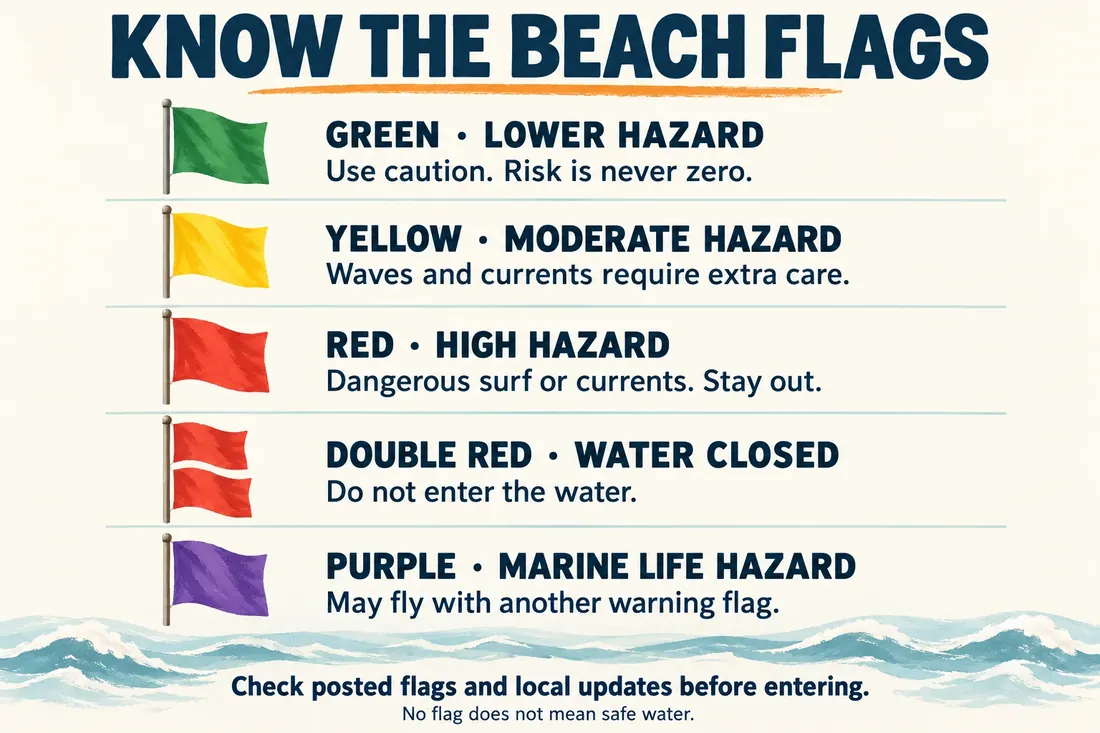
| Flag | Meaning | What to do |
|---|---|---|
| Green | Low hazard. Calm surf and currents. | Swim with the usual care. Calm does not mean current-free — keep an eye on children and weak swimmers. |
| Yellow | Medium hazard. Moderate surf and/or currents. | Weak swimmers should stay out. Everyone else: stay shallow, stay together. |
| Red | High hazard. Strong surf and/or currents. | Stay out of the water. The beach is still open — the water is not worth it. |
| Double red | The water is closed to the public. | Do not enter. Under a double red flag it is illegal, not just unwise. |
| Purple | Dangerous marine life — usually jellyfish or stingrays. | Not a shark warning. Shuffle your feet in the shallows, and keep children close. |
| Red over yellow | A lifeguard-supervised swimming area. | Swim between the flags. This is the safest water on the beach. |
| Red and white (quartered) | Emergency evacuation. | Leave the water immediately and follow instructions from lifeguards or police. |
Flags can change during the day. If the wind picks up in the afternoon — which it usually does here — the flags can go from yellow to red in an hour. Look again before you go back in.
Who decides, and how to check
The town sets the flags each day based on surf conditions and the rip current risk forecast. You will see them at the beach accesses; on days when the risk is high, the town also posts the flag colour on its social channels.
- Before you drive out: call the Town of Dauphin Island at 251-861-5525.
- When you arrive: read the nearest flag before you park. It is the fastest answer you will get.
- If a flag pole is empty: that is not permission. It means nobody has posted a reading — treat it as unknown and stay cautious.
Rip currents: what to do
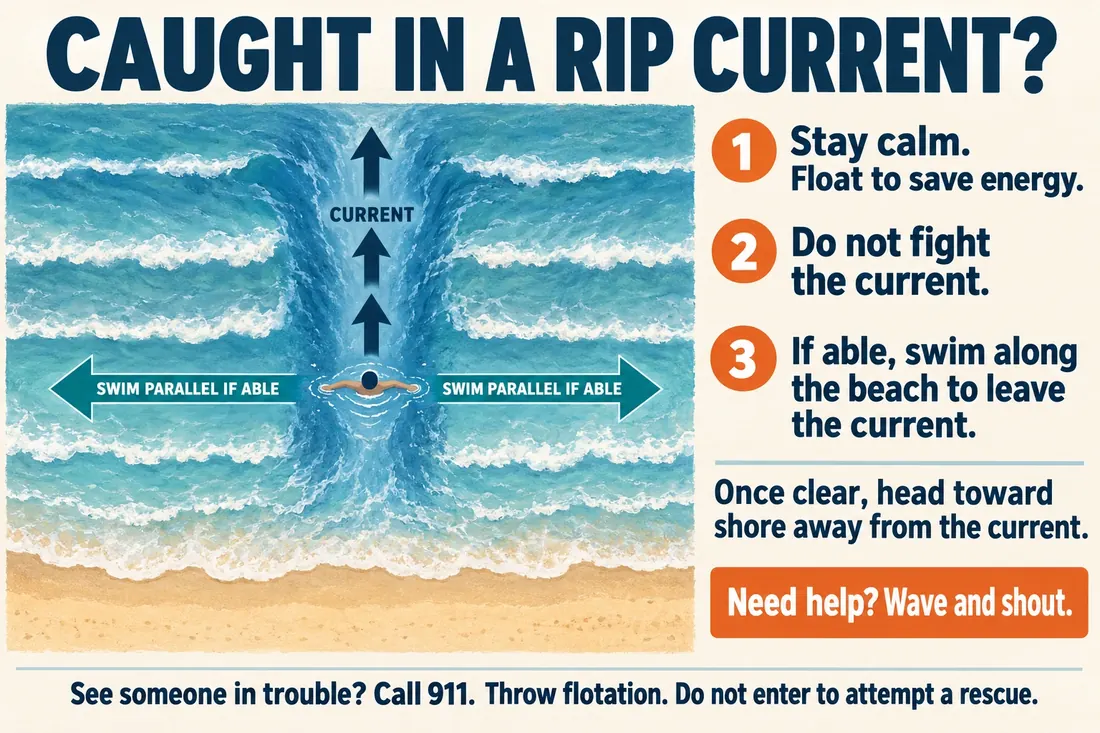
The diagram shows the shape of it: a narrow channel of water running straight out to sea between the breaking waves. The arrows along the beach are the way out — sideways, not straight back.
If you feel yourself being pulled away from the beach, the instinct to swim straight back will exhaust you and get you nowhere. Do this instead:
- Do not fight it. Rip currents are faster than any swimmer.
- Swim parallel to the shore — left or right — until the pull stops. Rip currents are narrow, often only a few metres wide.
- Then angle back in toward the beach.
- If you cannot make progress, float. Rip currents pull you out, not under. Float, conserve energy, raise an arm and shout for help.
- Get help. If someone else is caught, do not swim out after them — shout instructions, call 911, and point them sideways.
Practical rules for the island
- Unguarded water is the norm. Lifeguard cover is seasonal and limited to the town beaches — most of the shoreline has nobody watching.
- Watch the kids, not the view. Children get into trouble quickly and quietly.
- Skip the water after drinking. Most adult drownings involve alcohol.
- Stay off the dunes and out of the flagged nesting areas. Sea oats hold the island together and turtles nest there.
- Emergency: call 911. Beach medical assistance on the island: Dauphin Island Police, 251-861-5523.
Before you go
Pair this with the beach guide for which beach is which and where to park, and the travel tips for the ferry, parking rules and local advice.
Which beach is which?
West End, Middle, East End — and what parking costs.